Archive DeskFeature
Distillery District History: Windmill to Arts Hub in Toronto
Follow the Distillery District from an 1830s windmill and a surplus-grain still to a National Historic Site and a village of studios, with every date sourced.
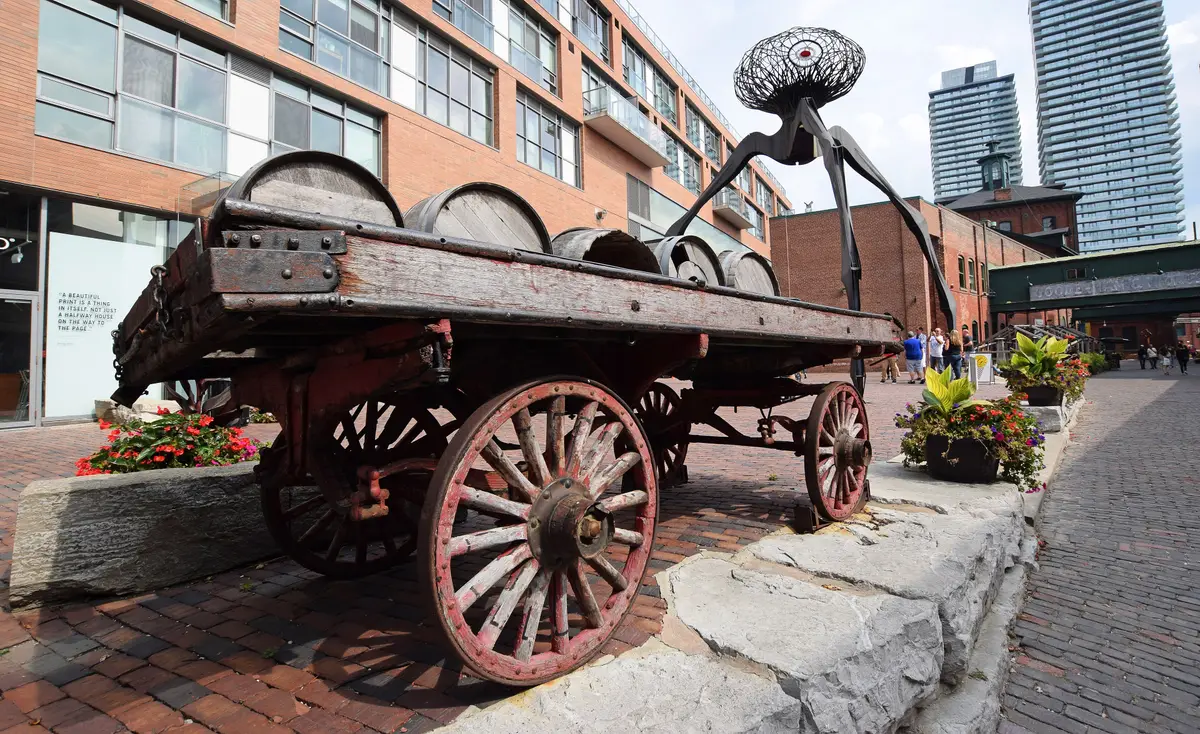
Start with a windmill. In 1831 a flour miller began building one near the mouth of the Don River, and the story of the Distillery District grows from that mill. Here is the timeline, with each date tied to its source.
How did a windmill become a distillery? (1831 to 1837)
The Dictionary of Canadian Biography says James Worts began moving two families to Upper Canada in 1831, set up as a flour miller near York and began building a windmill. His brother-in-law William Gooderham followed in 1832 with a company of some 54 people, invested in the mill, and the two formed a partnership. The district’s own tour says the 70-foot windmill on the edge of Toronto Bay soon became a symbol of the new City of Toronto.
The wind, it turned out, was not a reliable boss. The tour says the firm installed one of the earliest steam engines in Toronto when the wind proved too erratic. Then came the pivot. The City says that in 1837 Gooderham established Toronto’s first permanent distillery at the mouth of the Don River, using surplus grain from the milling business. Parks Canada puts the same moment this way, in its own wording: a still was set up on the site to convert surplus grain from an 1832 grist mill into whisky.
A smile, courtesy of the City’s online exhibit: nearly a third of that first batch of whisky was bought by a storekeeper on King Street East near Frederick Street.
When did the Stone Distillery rise? (1845 to 1895)
James Gooderham Worts joined his uncle as a full partner in 1845, and the firm became Gooderham and Worts. A major expansion began in 1859 with a five-storey distillery built under the direction of Toronto architect David Roberts. Parks Canada dates the large stone distillery to 1859 to 1861, with the brick malthouse, kilns, warehouses, shops and offices following before 1900.
The numbers climbed quickly. The district’s tour says production capacity grew from 80,000 to two million gallons a year once the new plant was running. It adds that a malt house and cooperage were added in 1864, and ten alcohol-storage buildings went up between 1879 and 1891 to meet a government requirement to age whisky before selling it.
The City’s exhibit says construction on the site continued until 1895, when the last building, the Fire Pump House, was completed. The tour credits architects David Roberts Sr. and David Roberts Jr., a father and son team, with the design of all the Victorian buildings on site. It may explain why the lanes look as if one hand drew them.
How big did Gooderham and Worts get?
Two sources, two flavours of pride. The district’s tour says the little windmill grew into the largest distillery in the British Empire and, for a time, the world. The City’s exhibit says that by 1877 the firm was hailed as the largest distillery in the world, with a private wharf, grain elevators and a cooperage. The firm also kept a downtown headquarters. The City’s Old Town brochure says the Gooderham Building, built in 1892, was the business headquarters of the distilling company. You know it as the Flatiron, and it features on our Old Town walking tour.
What happened in the twentieth century?
The site changed jobs. The City says that in 1916 the complex was leased to the Imperial Munitions Board as a chemical manufacturing factory that made about 1,000 tons of acetone a year. After the First World War, the City says, the distilling operation stayed dormant until it was bought in 1923, and four years later Gooderham and Worts was merged with Hiram Walker Ltd. By 1957 the company had ceased all whisky production at the site, and the plant shifted to rum and industrial alcohol.
In 1987 the company was sold to Allied Vintners. The City says the plant continued to produce liquor until 1990, when it closed, and that Cityscape Holdings bought the property in 2001 to develop it as an arts and entertainment destination.
How did it become a National Historic Site?
Before the redevelopment, the heritage recognition. Parks Canada says Gooderham and Worts Distillery was designated a national historic site in 1988. It was named, Parks Canada says, because it is an imposing landmark whose buildings collectively bear witness to the evolution of the Canadian distilling industry. Part of the value it lists is the completeness of the complex in illustrating the entire distillery process, from raw materials to storage of finished products for export.
A City Planning report adds that portions of the area were designated under Part IV of the Ontario Heritage Act in 1976 and 1997, and that the core was designated a National Historic Site in 1988. The district’s tour makes its own claim for the place: that it is the most intact Victorian-era industrial site in North America.
When did the district open to the public?
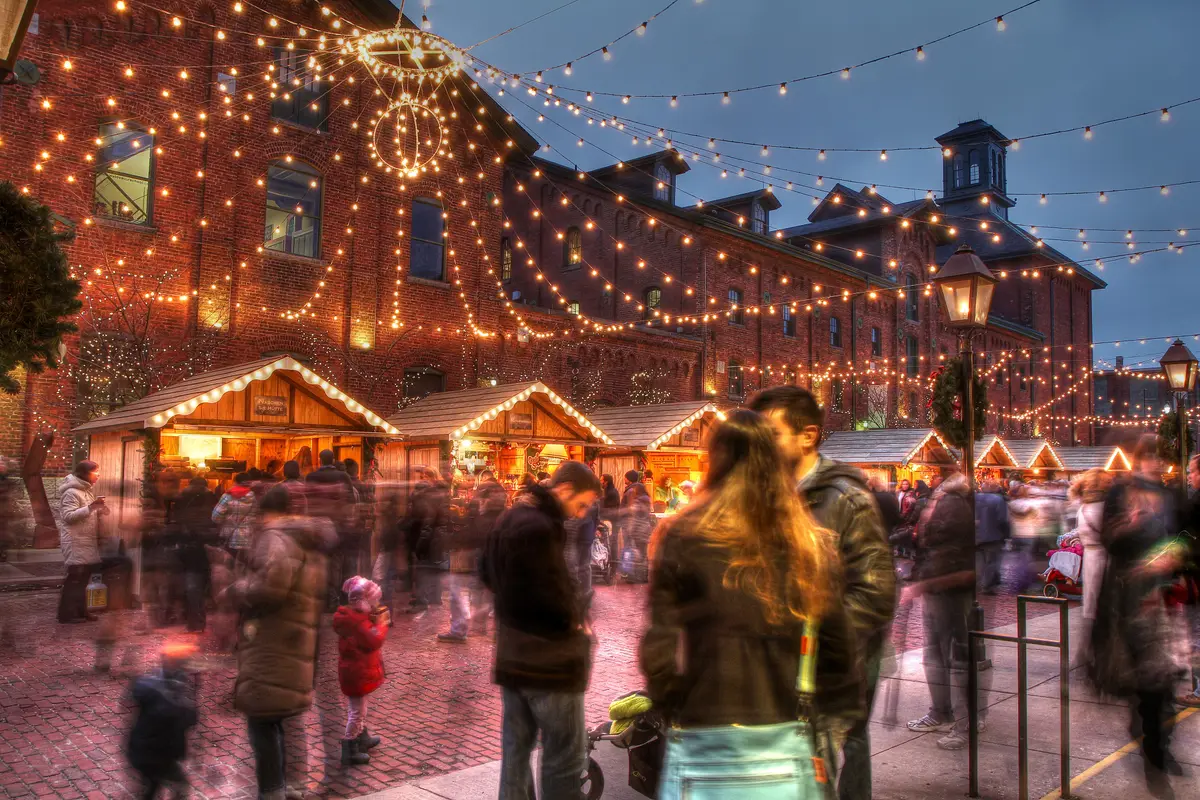
The district’s own account says the Distillery Historic District opened in 2003. Its tour describes the plant as reborn that year as an arts, entertainment and cultural district. If you came for the winter season, our Distillery Winter Village guide covers it.
How many buildings are there, really?
It depends who is counting and when. Parks Canada describes 30 brick and stone industrial buildings on 13 acres, built between 1859 and 1927. The district’s tour refers to 40 Victorian buildings, and its About page speaks of restoring 47 buildings. We give each count as its source states it, and take the gap as a reason to walk the lanes yourself.
How can you read the history on site?
Look for plaques. The district’s 2021 self-guided tour says Heritage Toronto plaques at the principal entrance to each heritage building give the original use and construction date. It also says hundreds of industrial artifacts remained when the distillery closed in 1990, and that exhibits of them have been installed at several locations in the district. It lists a giant 1895 steam pump among them.
The City’s walking tour of the St. Lawrence neighbourhood adds a small fact for the road: Gooderham and Worts Ltd. was established in 1832, two years before the Town of York became the City of Toronto, and Mill Street was named for a windmill that stood there. For the market half of the same walk, read our history of St. Lawrence Market or start at the Distillery District neighbourhood page.
Send this to the friend who thinks the Distillery District only exists in December.
Sources (8)
- Gooderham and Worts Distillery National Historic Site, Parks Canada
- GOODERHAM, WILLIAM (1790-1881), Dictionary of Canadian Biography
- Made in Toronto: Whiskey and Beer, City of Toronto
- Distillery District Heritage Conservation District: From Study to Plan, City of Toronto
- From Town to City and Beyond: A Self-guided Historical Walking Tour of the St. Lawrence Neighbourhood, City of Toronto
- Old Town Toronto West: Where downtown meets Old Town, City of Toronto
- The Distillery Historic District Self-Guided Tour, The Distillery District
- About Us, The Distillery District
Spotted something out of date? Let us know.
How did this land?
Share this
“Saving this for a slow Saturday: the Distillery District's story, from a windmill on the lake edge to a village of studios.”