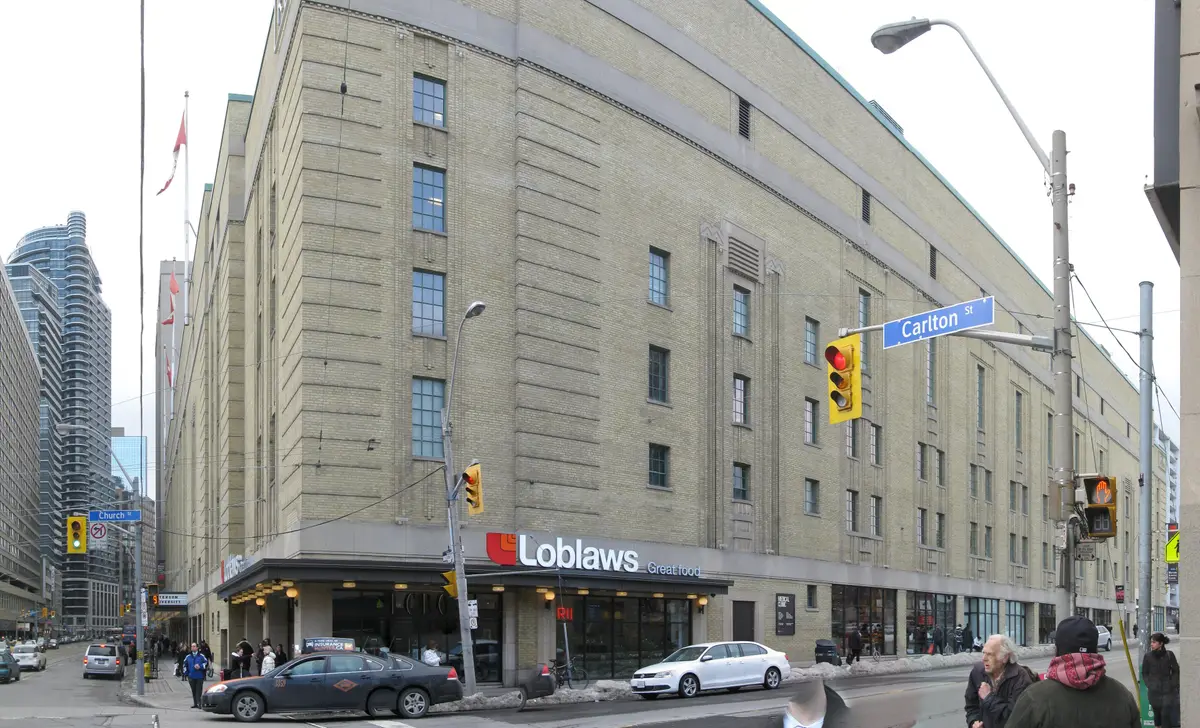
The Canadian Register of Historic Places says this suite of rooms was designated a national historic site in 1983 as outstanding examples of Art Deco interior design. It was designed by French architect Jacques Carlu, muralist Natacha Carlu and architect René Cera, built in 1930 and opened in 1931, then sealed off by 1970 until restored from 2000 to 2003. The Round Room is a domed circle within a square, with surviving mural paintings. The Register says the restored rooms are now a private events venue, so enjoy this one as a stop to know about and check the Register entry for access.
City DeskGuide
Toronto Architecture Walk: 100 Minutes Through 100 Years
The City's Hundred Years of Architecture route, stop by stop: eight National Historic Sites, from an estate house of about 1817 to an Art Deco round room.
Toronto rewards anyone who walks slowly and looks up, and the City has already drawn the map.
What is the Hundred Years of Architecture walk?
It is a self-guided route the City of Toronto lists in its urban tours, with an estimated time of one hour to less than two hours. The City describes it as a walk past architectural jewels that are outstanding national examples and have been designated as National Historic Sites. The City’s route map for the “North Loop” gives an estimated distance of 5 km and an estimated walking time of 100 minutes.
The City’s reasoning is hard to argue with: a look at a building’s architecture can reveal the period it was built in, the materials available and the purpose of the building. The City’s route map lists nine stops. Below we take you through the first eight, in the City’s order, with a note on what to look for.
One bit of honesty about the title: the buildings on our list date from about 1817 to 1931, a little more than a century. That is close enough that we are happy to call it a hundred years.
Which buildings are on the route?
Built between 1856 and 1859 at 15 King’s College Circle. Look for the towered south-facing front, the two wings reaching north and the medieval-inspired round building that was originally meant to be a chemistry theatre. The Register says it was designated in 1968 as one of the oldest collegiate buildings in Canada. After a fire in 1890 destroyed much of the eastern end, reconstruction under architect David Dick was completed in the style of the original.
At 186 Beverley Street, a three-storey Victorian residence with a red brick mansard roof, carved stone trim and cast iron garden railings. It was built for George Brown, a Father of Confederation, between 1875 and 1877. It is the quietest of the stops, so use it to slow down.
Built about 1817 for D’Arcy Boulton Jr., the Grange is the earliest building on our list. The Register says the house became the property of the Art Gallery of Ontario in 1911 and has operated as a museum since. Check the gallery’s site for current access.
At 130 Queen Street West, this Palladian-style building and its grounds occupy an entire city block. The stone and wrought-iron fence with its elaborate entrance gates is half the show. The original building was erected in 1829 to 1832 to designs by John Ewart, assisted by Dr. W.W. Baldwin. Its interiors include the Great Library, the Rotunda and a wood-panelled dining room for law society members. It was designated a national historic site in 1979 and has been headquarters of the Law Society since 1832.
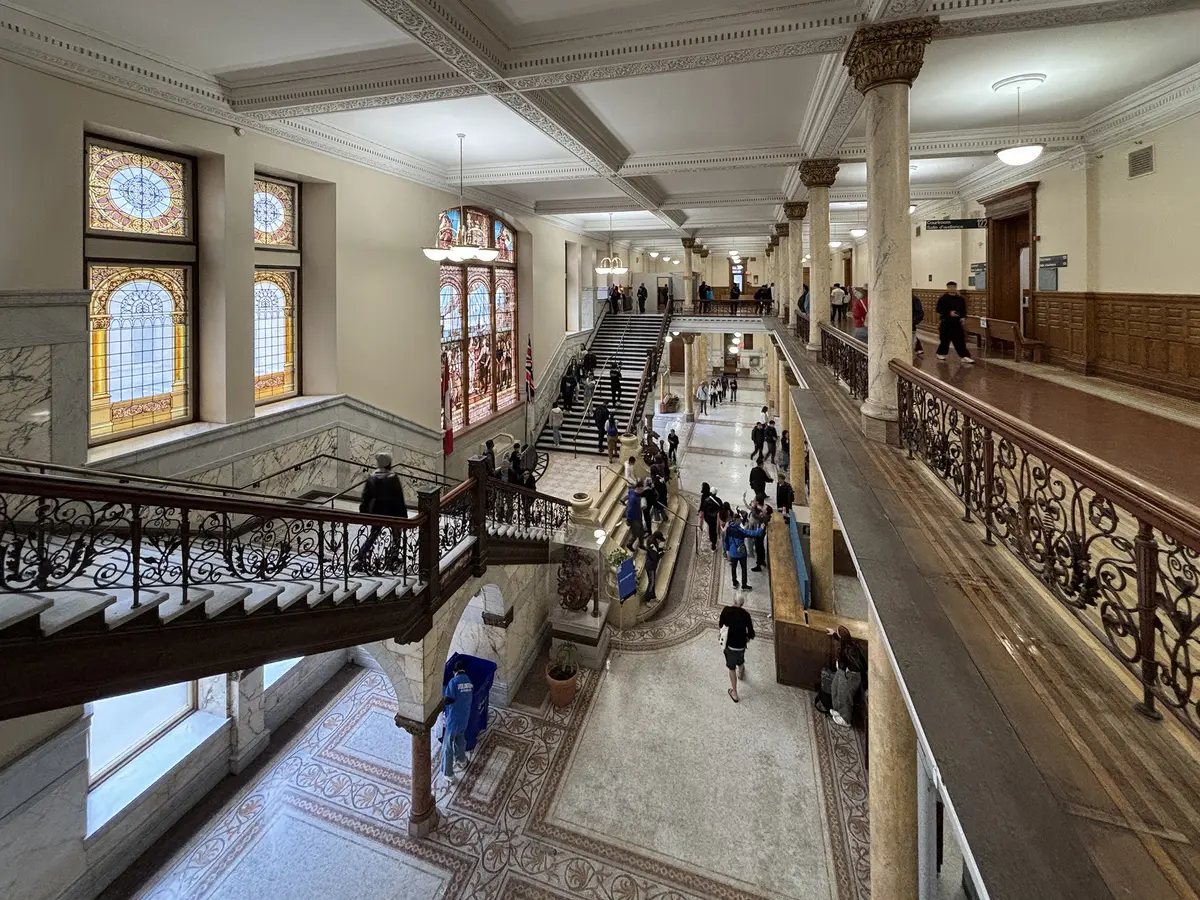
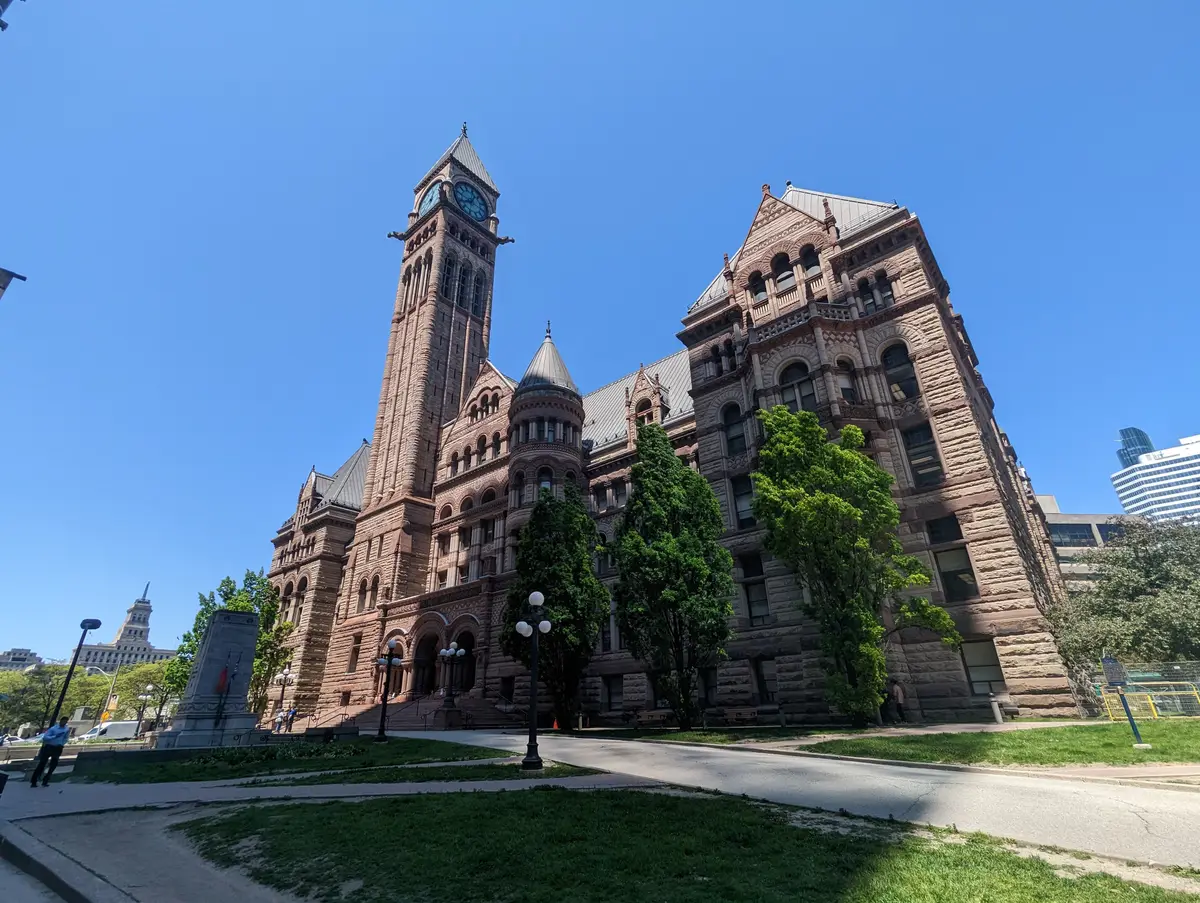
At the corner of Queen Street West and Bay Street. E.J. Lennox designed it between 1883 and 1886, and it was built from 1889 to 1899. The Register notes the tall, off-centre clock tower lines up with the axis of Bay Street. The City says the red sandstone is adorned with carvings of animals and humans, and a Cenotaph was erected on the lawn in 1925. The Register says it was designated a national historic site in 1984. Step into the lobby, if it is open, for one of the city’s few secular stained-glass windows.
At 189 Yonge Street, a double-decker theatre complex. Designed by architect Thomas Lamb, the Elgin opened in late 1913 and the Winter Garden upstairs in early 1914. The Winter Garden’s naturalistic, “atmospheric” decor stayed virtually untouched for more than half a century. Both theatres were restored by the Ontario Heritage Foundation in the 1980s. The best way to see inside is a show, so check the theatres’ own listings.
At 95 Queen’s Park Crescent, a red-brick student residence in the Queen Anne Revival style, designed by G.M. Miller and built in 1902 and 1903. The Register says it was the first purpose-built women’s residence on a Canadian university campus, and that it was designated because it is a particularly good example of Queen Anne Revival institutional architecture.
The City’s ninth stop is the Chapel of St. James-the-Less. We have left it off our write-up, so use the City’s map to add it.
What styles will you spot along the way?
Treat the route as a style-spotting game. Romanesque Revival shows up at University College, Palladian at Osgoode Hall, Richardsonian Romanesque at Old City Hall, Queen Anne Revival at Annesley Hall and Art Deco in Eaton’s Round Room. Once your eye learns the differences, the rest of downtown starts to sort itself the same way.
How do you walk it without getting lost?
Download the City’s route map and carry it, since the numbered stops follow the City’s loop. Pair the walk with our Toronto City Hall architecture feature, which picks up where Old City Hall’s story leaves off, or finish at Union Station. If rain or cold changes your plans, our downtown walking tour works in the PATH. Looking for more? The Toronto architecture guide has the full picture, and our Art Deco guide follows Eaton’s Round Room further.
Send this to the friend you would bring for a long, looking-up kind of Saturday.
Sources (11)
- Urban Tours, City of Toronto
- National Historic Sites Urban Walks: A Hundred Years of Architecture, North Loop (route map), City of Toronto
- Eaton’s 7th Floor Auditorium and Round Room National Historic Site of Canada, Canadian Register of Historic Places (Parks Canada)
- University College National Historic Site of Canada, Canadian Register of Historic Places (Parks Canada)
- George Brown House National Historic Site of Canada, Canadian Register of Historic Places (Parks Canada)
- The Grange National Historic Site of Canada, Canadian Register of Historic Places (Parks Canada)
- Osgoode Hall National Historic Site of Canada, Canadian Register of Historic Places (Parks Canada)
- Old Toronto City Hall and York County Court House National Historic Site of Canada, Canadian Register of Historic Places (Parks Canada)
- Visiting Old City Hall, City of Toronto
- Elgin and Winter Garden Theatres National Historic Site of Canada, Canadian Register of Historic Places (Parks Canada)
- Annesley Hall National Historic Site of Canada, Canadian Register of Historic Places (Parks Canada)
Spotted something out of date? Let us know.
How did this land?
Share this
“Saving this for a crisp weekend: a self-guided Toronto architecture walk through eight National Historic Sites.”