Toronto Public Library Branches Worth Visiting for Architecture
Seven Carnegie-era Toronto Public Library branches still serve readers today, from Yorkville's columns to Weston's stained glass and a 2022 Wychwood reopening.
Some of Toronto’s loveliest rooms are free to wander into, and they come with books.
Andrew Carnegie funded ten public libraries in what is now Toronto. Seven of them are still used as Toronto Public Library (TPL) branches, so you can walk in, borrow a book and admire a century-old ceiling in the same visit. This guide follows them in order of opening, using TPL’s own history pages for every date and architect.
How did Toronto get its Carnegie libraries?
TPL says the first grant, in 1903, was the largest given anywhere in Canada. It paid for a new central library in 1909 and three branches: Yorkville (1907), Queen and Lisgar (1909) and Riverdale (1910). A second grant, received in February 1915, paid for three almost identical branches: Beaches, High Park and Wychwood, all opened in 1916.
One condition of the grants says a lot about the city’s civic habit: they went only to public libraries that were open to citizens free of charge.
The branch at 22 Yorkville Avenue opened on June 13, 1907, the first of the four libraries built with the 1903 grant. Robert McCallum, the City Architect, gave it a classical Beaux Arts style, with two pairs of columns, a projected portico, Doric capitals and a bracketed cornice. TPL calls Yorkville its oldest library.
It replaced an earlier branch, Northern, which had opened as TPL’s first library in February 1884, the first year of free public library service in the city.
The Yorkville branch, with its columned entrance.Dhodges at English Wikipedia / Wikimedia Commons / CC BY-SA 3.02
Opened on September 1, 1909 as the Western Branch, it was renamed Annette Street in 1962. Ellis & Connery designed it with Edwardian Classicism features: orange-red brick, Ohio sandstone and Corinthian columns.
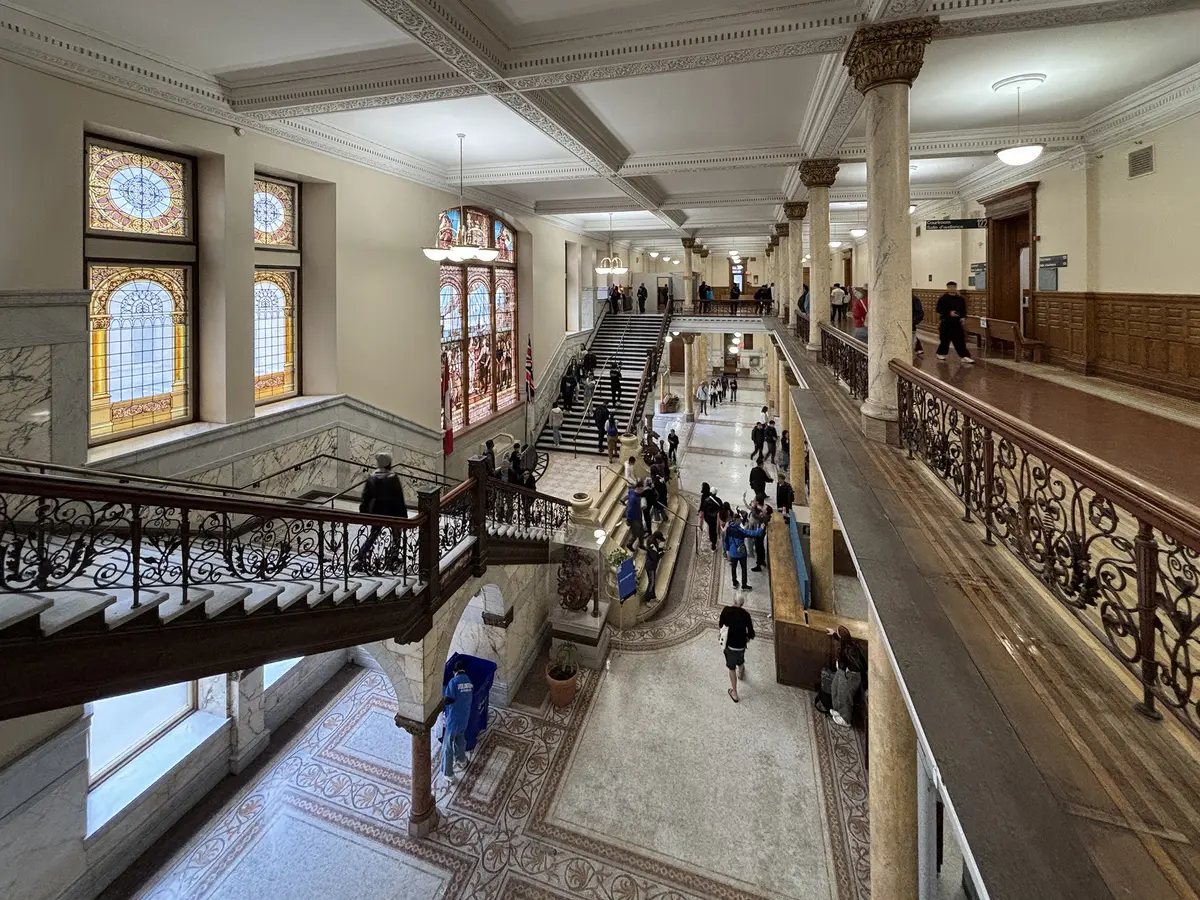
The inside has a good story. The rotunda ceiling was covered in 1962 and revealed again in the 1980 renovation. Look up when you step in.
Riverdale, at 370 Broadview Avenue, opened on October 19, 1910. Robert McCallum designed it in a Georgian Revival style, in red brick with white Ohio sandstone trim. It stands at the corner of Broadview and Gerrard, and TPL says it was one of only six corner library buildings built in Ontario with Carnegie funds.
TPL says it was also one of the first libraries in Toronto designed with an open-shelf system, which let borrowers browse for books themselves.
At 2 King Street, Weston’s library opened on December 29, 1914. Lindsay & Brydon gave it a simple Arts and Crafts design, enriched by stained-glass windows and Art Nouveau mosaic panels, which TPL calls a unique feature among Ontario’s Carnegie libraries. In 1978, York City Council passed a designation bylaw for the building under the Ontario Heritage Act.
The Weston branch, Toronto Public Library.Alaney2k / Wikimedia Commons / CC BY 4.05
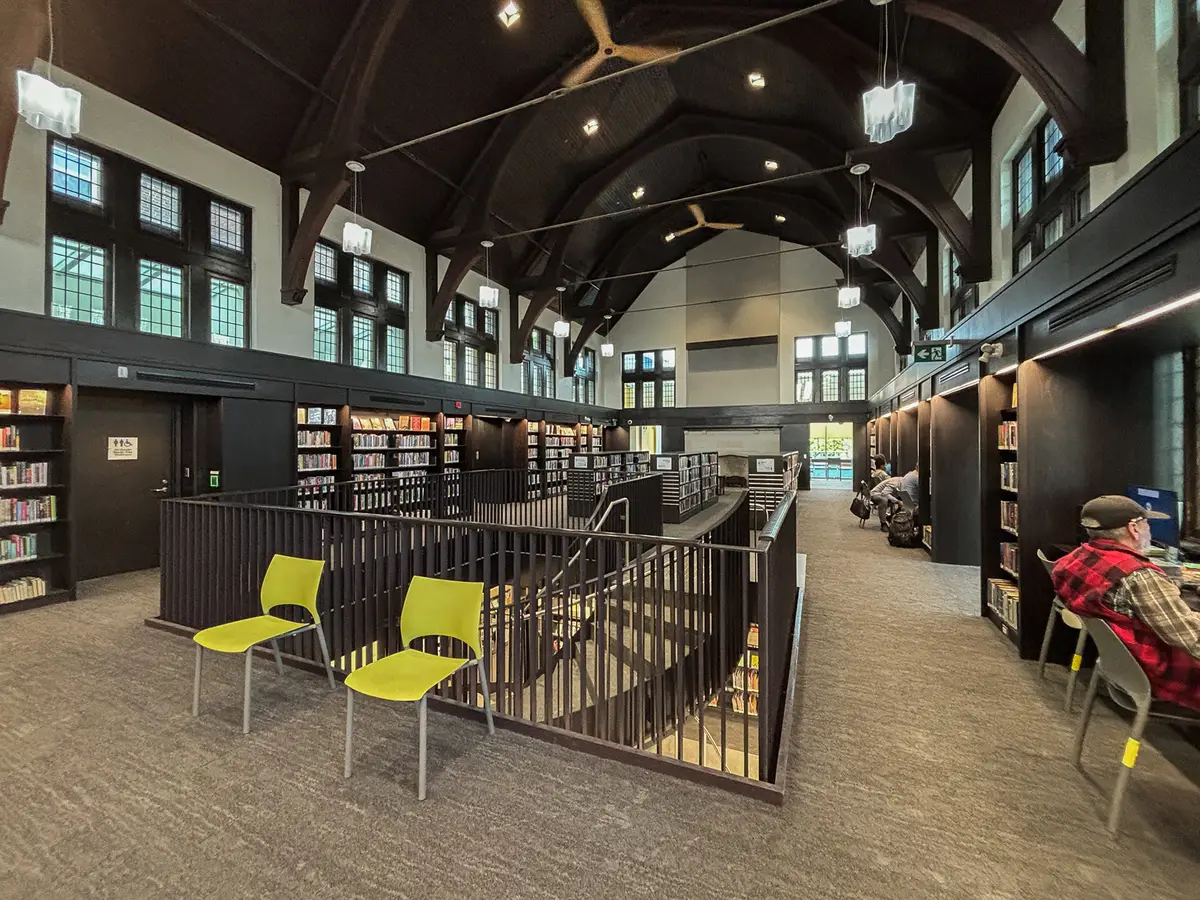
Wychwood, at 1431 Bathurst Street, opened on April 15, 1916 and was the prototype for three identical libraries: Wychwood, High Park and Beaches. The design is an adaptation of the Tudor Gothic style.
The newest chapter is the best one to see. The branch reopened in October 2022, more than double its size, with the historical building preserved and a two-storey addition.
The branch at 228 Roncesvalles Avenue opened on October 31, 1916, to a design by Eden Smith & Sons. It started as one of three identical libraries, and all three have since been renovated and are no longer the same. Pair it with a stroll through High Park on the same afternoon.
Eden Smith & Sons designed the branch at 2161 Queen Street East, which opened on December 6, 1916, at the northeast corner of Kew Gardens. It was the last of the three identical branches.
A one-ton cast bronze owl was installed at the entrance on July 7, 2005. Heritage Toronto and TPL presented a heritage plaque here on September 30, 2006. A January 2005 Beach Metro Community News article, reproduced on TPL’s Beaches page, described a restored loft at the north end of the building as a quiet study area with tall windows overlooking Queen. Our Beaches neighbourhood guide has more for the same trip.
How many architectural styles are on the list?
Five, among the branches whose TPL pages name a style. Yorkville is Beaux Arts. Annette Street shows Edwardian Classicism. Riverdale is Georgian Revival. Weston is Arts and Crafts. Wychwood is Tudor Gothic. That is a lot of range for one library system, and it makes the branches a fun set to collect.
Which Carnegie buildings have new uses?
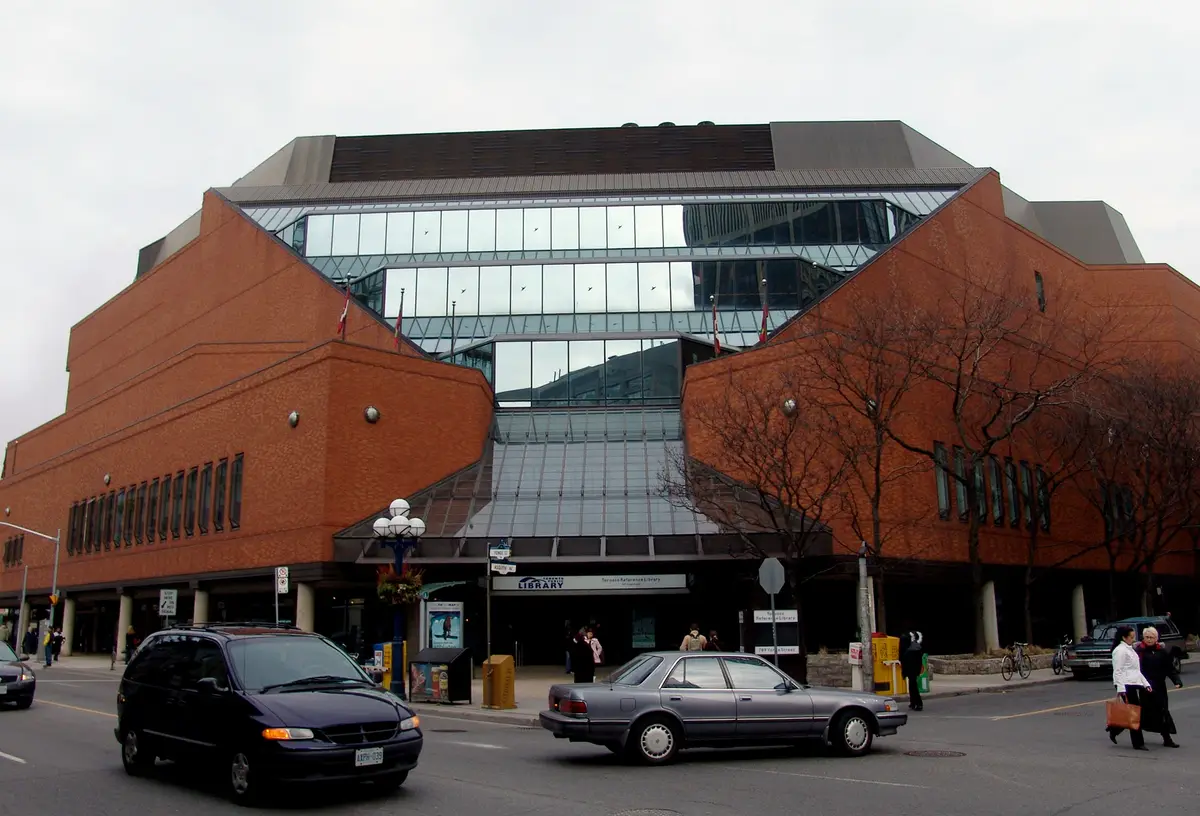
Two have found new lives. TPL says the former Queen and Lisgar library at 1115 Queen Street West is now in use by the Theatre Centre. TPL lists the former Central library at 214 College Street as opened in 1909 and closed in 1977, replaced by Toronto Reference Library, and now in use as the Koffler Student Centre at U of T. For the successor’s story, see our Toronto Reference Library guide.
How do you plan a library architecture day?
These are working libraries, so visit the way locals do: step in, look up, look around, borrow something and take your time. Bring a camera for the ceilings and a library card for the shelves. Then group branches by side of town. A west-end day can take in Annette Street, High Park and Wychwood. An east-end day pairs Riverdale with Beaches. Weston and Yorkville each deserve their own trip. Add the buildings to a wider walk with our Toronto architecture guide and check each branch’s TPL page for hours, because the doors are the point.
Browsing, not working? Our libraries to work from list covers the branches with study rooms instead.
Send this to the friend who would happily spend a Saturday looking at ceilings.