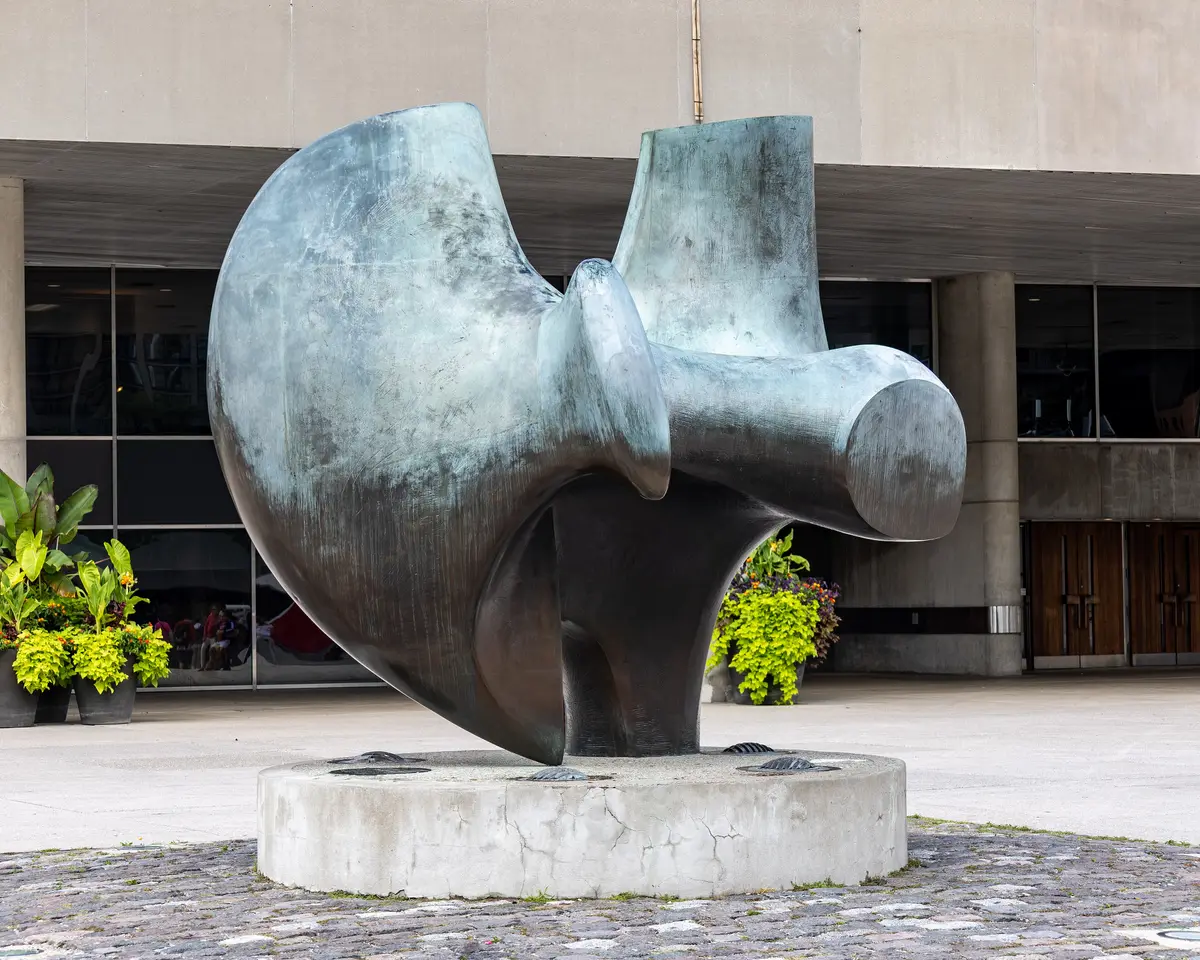
Henry Moore’s The Archer is a 2.5 tonne bronze free-form statue that rests on a concrete base, and its official name is Three-Way Piece No. 2. It was installed in Nathan Phillips Square in 1966, and the unveiling was held on October 27, 1966. City Hall’s architect, Viljo Revell, asked Moore for a statue that would complement the building’s design. The sculpture was bought through a public subscription fund launched by Mayor Philip Givens. Walk all the way around it. The shape changes from every side.
Culture DeskGuide
Public Art in Toronto: Sculptures and Monuments Worth Finding
From Henry Moore's bronze at Nathan Phillips Square to a rotating sculpture garden on King Street East, here is where to find the City's public art.
Some of Toronto’s best art has no ticket line and no coat check. It is just there, on a square or in a small park, waiting for you to look up.
Where do you find a map of Toronto’s public art?
Start with the City’s Public Art Map, which lets you explore more than 450 works of public art across Toronto. It records art from two City programs, the Public Art & Monuments Collection and the Percent for Public Art Program, plus other artwork visible in the public realm that was catalogued during the Year of Public Art in 2021. Locations are approximate, so treat each pin as “somewhere on this block.”
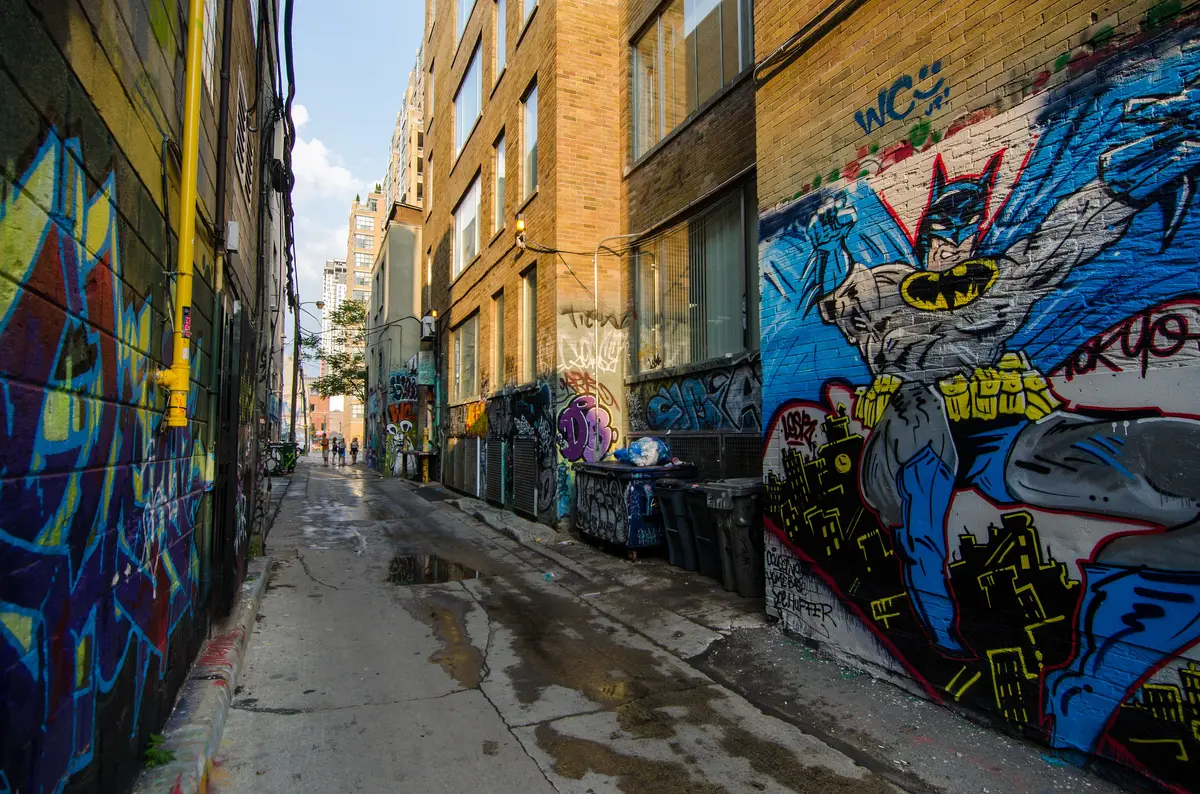
Murals and projects commissioned by StreetARToronto sit in a separate catalogue at streetartoronto.ca. If it is walls you want, our guide to Toronto murals picks up where this one stops.
What is the City’s public art collection?
The City runs three public art programs: the Public Art & Monuments Collection, the Percent for Public Art Program and StreetARToronto. The collection’s legacy dates from the middle of the 19th century and it holds close to 400 works. It keeps growing through commissions and donations. The Percent for Public Art Program covers privately owned art designated as a public benefit.
Which sculptures and monuments should you find first?
Our pick is a loop of seven. Five are at or beside Nathan Phillips Square, one is on King Street East and one is up in North York.
Oscar Nemon’s statue is a three-metre-high, rough textured bronze, also known as the Winston Churchill Memorial. It stands at the northwest corner of the Square, in Sculpture Court.
Ken Lum’s monument presents a 3D printed bronze topographical map of the town of Ortona. It honours Canadian soldiers who fought in the Italian Campaign in the Second World War, with a bronze soldier statue at each corner of the map. It is a quiet place to stop in the middle of a busy square.
The Spirit Garden is a 20,650-square-foot Indigenous cultural space in Nathan Phillips Square. At its centre is a two-metre-tall limestone Turtle sculpture, and each element was created by Indigenous artists representing First Nations, Inuit and Métis cultures. The Toronto Council Fire Native Cultural Centre developed the garden in partnership with the City.
David Partridge’s Metropolis was selected in an art competition held in 1974 and was created from more than 100,000 common nails. It runs along the east wall inside the main doors of City Hall. Step close, then step back, and the nails turn into a picture of a city.
This small City park has commissioned temporary artworks since it opened in 1981. It is at 115 King Street East, just east of Church Street and directly across from St. James Cathedral. Exhibitions change twice per year, typically in the spring and fall. The City’s page lists Kristi Chen’s exhibition, SAMA SAMA, for October 2026 to April 2027. The garden is meant as a stepping stone between studio work and public art, letting artists experiment in public space. From 1981 until 2014 it ran as a partnership with the Louis L. Odette Family through a non-profit foundation, and it is now managed by the City.
“120 Mirrors” is a three-piece permanent public art installation by Public Studio & Anna Friz, commissioned by the City for the Lee Lifeson Art Park. The City’s 2014 naming report places the park between Hillcrest Avenue and Princess Avenue, immediately east of Gladys Allison Place, in Willowdale, and proposed naming it in honour of two Willowdale musicians, Geddy Lee and Alex Lifeson.
What else is tucked into Nathan Phillips Square?
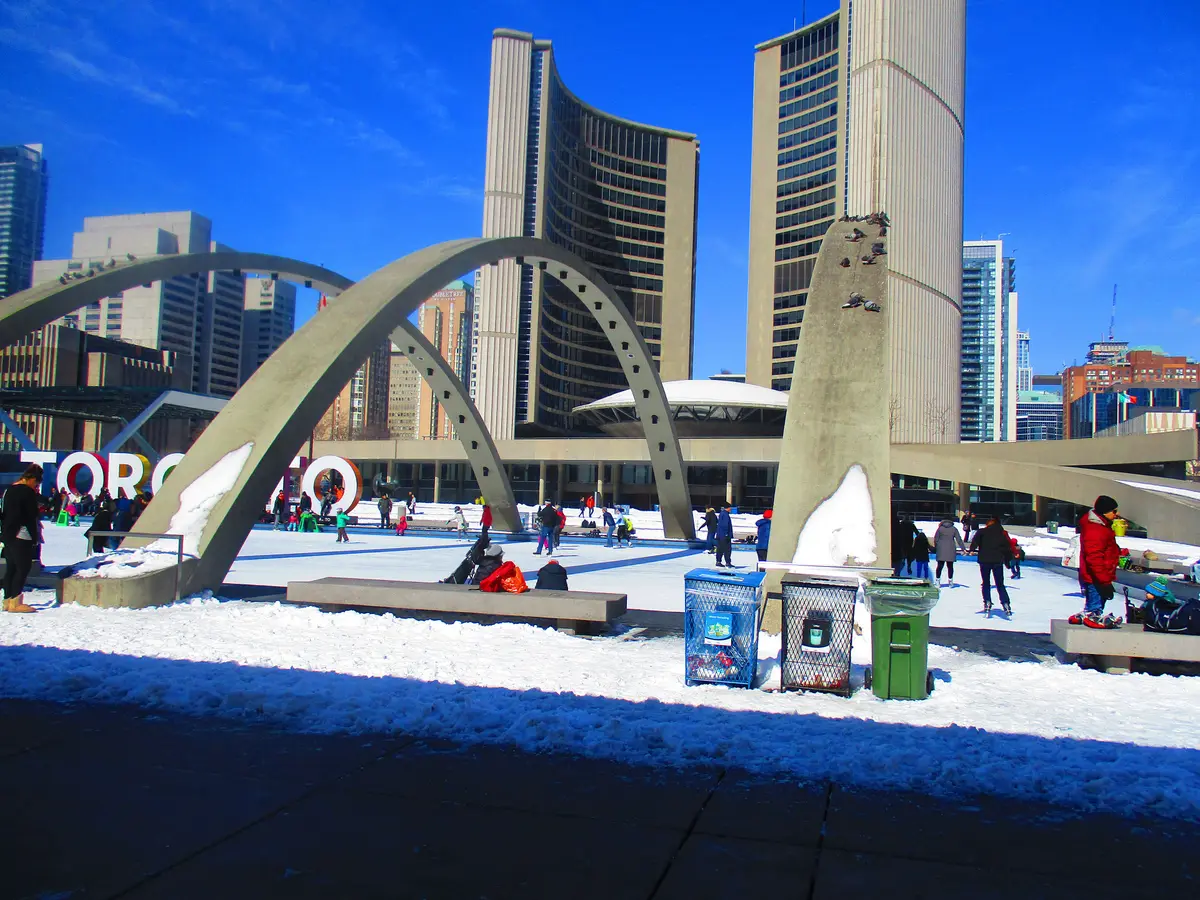
Look low as well as high. A piece of the Berlin Wall lies at the base of the centre freedom arch on the south side of the Square, embedded with a plaque. A 2.1-metre-high ancient white granite column was presented in 1957 to Mayor Nathan Phillips by the Hon. Umberto Tupini. And the TORONTO Sign stretches across the Square at three metres tall, with 3D letters, a Medicine Wheel and a maple leaf.
How do you turn this into a walk?
Our suggestion, not the City’s: begin at Nathan Phillips Square and take in the Archer, the Churchill statue, the Peace Through Valour Monument and the Spirit Garden in one slow lap. Step inside City Hall for Metropolis. Give the Square a leisurely lap rather than a dash, because most of these works reward a second look from a different angle. Our Nathan Phillips Square guide has the rest of the Square.
From there, head east to King Street and add the Sculpture Garden to a stroll through Old Town. Our Old Town walk gives you a route. The North York stop is its own trip, so pair it with a day in Willowdale.
Underground, there is more to find. If you only have a lunch break, pick one work, read what the City says about it and look properly. Our guide to TTC station art covers the art you can see on your commute. For the wider picture, browse the Culture desk.
Send this to the friend who stops to read every plaque.
Sources (8)
- Public Art, City of Toronto
- Public Art Map, City of Toronto
- Public Art & Monuments Collection, City of Toronto
- Public Art Competitions, City of Toronto
- Toronto Sculpture Garden, City of Toronto
- Features of Nathan Phillips Square, City of Toronto
- A Step Forward in Time: Public Art, City of Toronto Archives
- Proposal to Name New Art Park: Lee Lifeson Art Park, City of Toronto
Spotted something out of date? Let us know.
How did this land?
Share this
“Saving this for Saturday: the sculptures and monuments in Toronto you can see for free, from The Archer to the Spirit Garden.”